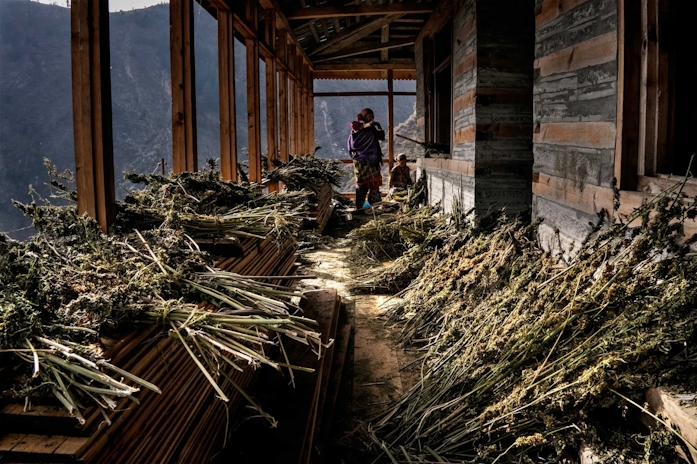
Andrea de Franciscis
Wild Weed: The Ancient Cannabis Fields Hidden in the Himalayas
Those viral photos of endless cannabis fields in the mountains? They’re real. Here’s the story behind them.

Weed growing freely across entire mountainsides sounds like a stoner’s fantasy. But in the Himalayas, it’s reality.
If you’ve scrolled past those viral Reddit posts or Instagram videos showing cannabis plants stretching across hillsides as far as the eye can see, you probably had the same reaction most people did: “No way that’s real.”
It is.
Weed in the Himalayas isn’t staged or exaggerated. Cannabis has grown freely in this region for thousands of years, and locals will tell you weed in the wild is as common as any other plant on the mountainside. As one Instagram user put it: “The weed is actually a weed here.”
Key Takeaways
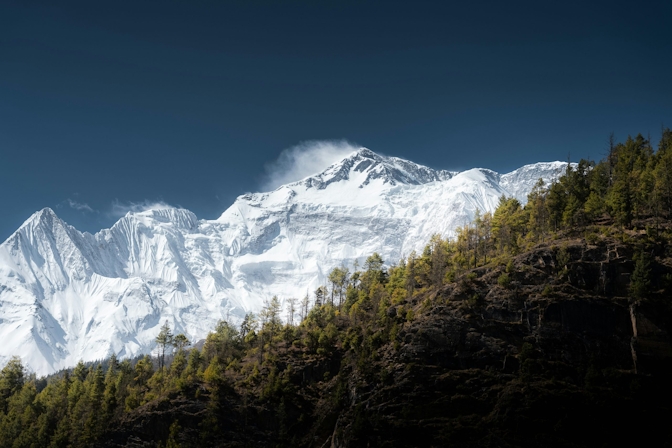
SÑAVA auchynnikau
- Weed in the wild grows naturally and extensively across large portions of the Himalayan mountains, confirmed by locals and peer-reviewed research
- Weed in the Himalayas didn’t originate there—researchers consider it a naturalized or invasive species that migrated into the region over thousands of years
- The high elevation, temperature, and humidity conditions of the Himalayas created ideal growing environments for weed in the wild to spread rapidly
- Himalayan weed typically tests around 6-10% THC, significantly lower than modern cultivated strains
- Locals rarely smoke the buds directly. Instead, they hand-press the flowers into charas (traditional hash) for consumption
- Some modern breeders still use pure Himalayan landrace genetics for cold resistance traits and resin production
Weed in the Himalayas: How Cannabis Took Over the Western Mountains
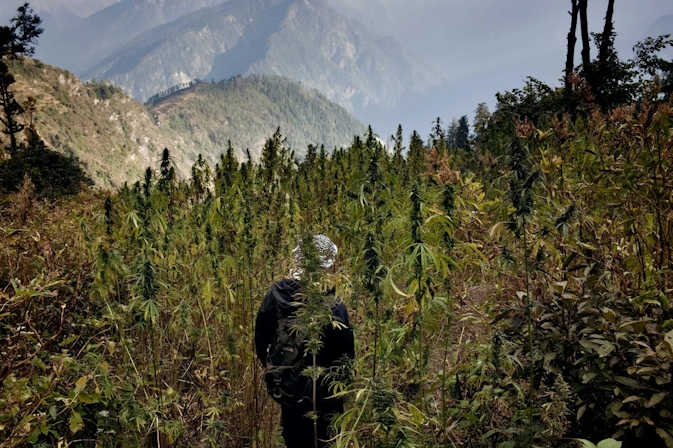
Andrea de Franciscis
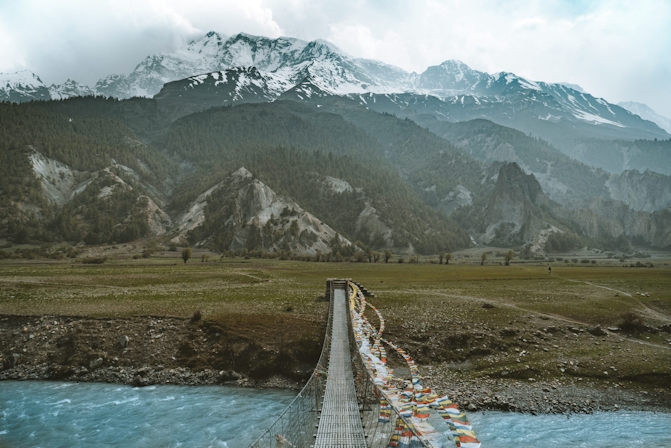
Walk through certain valleys in Nepal or northern India, and you’ll see weed in the Himalayas growing like it owns the place. Because in many ways, it does. Cannabis didn’t arrive here recently. Weed in the wild has been spreading across these mountain ranges for millennia, and today it grows so abundantly that many Himalayan weed field photos look almost too good to be true.
The plants grow tall, loose, and wild. Nothing like the manicured grows you see in commercial cultivation today. They blanket hillsides, line walking paths, and pop up in valleys where no one planted them. For locals, weed in the Himalayas isn’t so remarkable as it is just part of daily life.
But cannabis isn’t actually native to the Himalayas. Researchers classify weed in the wild here as a naturalized or even invasive species, meaning they arrived largely from natural migration of seeds and made themselves a comfortable home.
How Cannabis Reached the Himalayas
So where does weed grow in the wild originally? Scientists believe Cannabis sativa originated in Asia, with wild populations existing across Central Asia and the Tibetan Plateau millions of years ago. These regions sit right next door to the Himalayas, which set the stage for eventual migration.
After the last Ice Age ended around 20,000 years ago, plant species gradually moved south into the Himalayan hills and valleys as climates shifted. Around 12,000 years ago, humans began deliberately cultivating cannabis in surrounding regions. Escaped seeds spread easily across the mountainous terrain, and weed in the wild established itself throughout the range.
The Himalayan mountain weed you see today is the result of this long process—thousands of years of natural spreading, occasional human cultivation, and environmental adaptation.
Why the Himalayas Became Ideal for Wild Weed
Not every region can support massive wild cannabis populations, but the Himalayas hit a sweet spot. Research shows that elevation significantly impacts cannabis growth, affecting temperature, humidity, and overall growing conditions in ways that favor the plant.
The high altitude creates cooler temperatures that cannabis tolerates well, while the seasonal patterns provide the photoperiod changes the plant needs to flower. Combined with relatively low human interference in remote areas, weed in the Himalayas found conditions that let it spread unchecked across entire mountainsides.
Himalayan Weed vs. Modern Cannabis Today

Andrea de Franciscis
If you’re imagining that a Himalayan weed field produces the same dense, frosty nugs you’d grab from a dispensary, think again. Weed in the wild and cultivated cannabis provide very different experiences when consumed. Here’s a deeper look at the key distinguishing factors between weed found in the Himalayan mountains and those found at your local dispensary.
Appearance
Modern cannabis is bred to be dense, compact, and covered in visible trichomes. Weed in the wild grows tall and loose with airy, leafy buds that spread out rather than stack up. It looks more like the plant’s natural form before humans started optimizing it for bag appeal.
Potency and Effects
Weed in the Himalayas hasn’t been selectively bred for maximum potency as modern strains are today. Himalayan weed typically tests around 6-10% THC according to locals who’ve had it analyzed. Compare that to modern strains regularly reaching levels of 20-30%+ THC, and you’re looking at a significant gap in potency.
Since Himalayan weed contains a lower THC content, the resulting effects are typically milder, slower-building, and less overpowering compared to modern dispensary strains. Users often describe the effects as more functional, with less risk of anxiety, racing thoughts, or heavy sedation. There’s typically no sharp peak as you’d expect from high-THC modern strains—instead, the effects tend to feel steadier and easier to manage.
Use Cases
Locals in the Himalayan mountains rarely smoke the buds directly. Instead, they hand-press the flowers using a technique that creates charas—dark, sticky balls of concentrated resin similar in appearance to temple balls.
The process relies on friction. A skilled processor rubs fresh cannabis flowers between their palms, slowly pulling off trichomes (the resin glands containing cannabinoids). The resinous material accumulates into a hash ball that’s much more potent than the original flower. According to one Reddit user who lives in the Indian Himalayas, a skilled person can produce 30-50 grams of charas in a day, or around 10 grams of high-quality product. The charas typically get mixed with tobacco and smoked in traditional clay or stone pipes.
Genetics in Modern Breeding
Those wild Himalayan genetics haven’t disappeared from the cannabis world entirely. Some breeders still work with pure landrace seeds from Nepal and the Indian Himalayas, preserving these genetics for specific traits like cold resistance and high resin content. Modern hybrids have diluted most of these characteristics, but the original weed in the wild genetics still show up in certain breeding programs aimed at hash production. Weed in the Himalayan weed may not win potency contests, but its genetics remain valuable for specific breeding goals.
That long genetic lineage depends on one fragile constant: the environment itself.
The same high-altitude conditions that allowed wild cannabis to thrive for thousands of years are now changing rapidly. As glaciers retreat and temperatures shift across the Himalayan region, researchers are beginning to question what that means for plants that evolved to survive very specific mountain climates.
To understand how climate change could impact wild cannabis in the Himalayas, read our full breakdown here:
The Himalayas Are Melting—and It Could Affect Wild Cannabis Plants in the Region
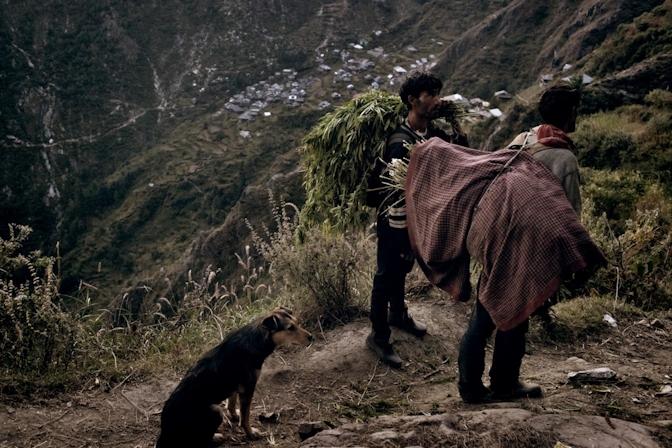
Andrea de Franciscis
Frequently Asked Questions
Where does weed grow naturally in the wild?
Weed in the wild grows in several regions worldwide, but the most notable populations exist in Central Asia, the Himalayas, parts of the Middle East, and scattered locations in Africa. The Himalayan region (spanning Nepal, northern India, Bhutan, and Tibet) contains some of the most extensive wild cannabis populations documented today. Weed in the Himalayas is very well-established due to thousands of years of natural spreading.
Are weed plants common to find in the wild?
It depends on where you are. Weed in the Himalayas and parts of Central Asia is extremely common, growing along roadsides, hillsides, and valleys. In most Western countries, true weed in the wild populations are rare, but feral hemp (escaped from historical cultivation) exists in some rural areas.
Does weed still grow freely in the Himalayan mountains?
Yes. Weed in the Himalayas continues to grow freely across large areas despite many efforts to remove it over the years. The plant is so well-established in the region that complete removal would be practically impossible. Locals often leave weed in the wild alone or use it for traditional charas production.
Is Himalayan weed the same as modern indica strains?
Not exactly. While Himalayan cannabis contributed genetics to what we now call “Indica” strains, modern Indicas have been heavily crossbred and selected for specific traits like higher potency and denser buds. Pure Himalayan landrace strains are genetically distinct from today’s commercial Indicas, though they share common ancestry.
Why do the Himalayan weed fields look so massive in photos?
Because those Himalayan weed field shots are showing real scale. Weed in the wild spreads aggressively when conditions are right, and the Himalayas provide ideal growing environments with minimal human intervention in remote areas. The plants have had thousands of years to establish themselves across entire mountainsides. Those viral photos aren’t using trick angles. Weed in the Himalayas really does cover that much ground.
Is wild weed stronger than cultivated cannabis?
No, it’s actually the opposite. Weed in the wild typically contains 6-10% THC, while cultivated cannabis often exceeds 20-30% THC. Modern breeding has focused intensely on maximizing cannabinoid content, creating strains far more potent than anything found growing naturally. However, weed in the Himalayas can still be processed into concentrates like charas, which significantly increases the potency of the final product.
The Herb Community
PETER THOMAS
For more than a decade, Herb has been a gathering place for people who love, use, and are simply curious about cannabis. What started as a small corner of the internet has grown into a community where millions come to learn, share, and stay connected to the culture.
Here’s what you can tap into at Herb:
- Learning hub and guides that break things down clearly, from growing weed outdoors to understanding how terpenes impact your high
- News hub that spotlights the latest cannabis culture and policy shifts
- Dispensary directory to help you find licensed shops in your local area
- Monthly strain picks, featuring rotating Indica, Sativa, and Hybrid favorites
- Deals page, updated monthly with the best cannabis discounts available online
Stay connected with the Herb community by subscribing to our newsletter, following us on Instagram, and X for the latest in cannabis lifestyle and culture.
Herb Recommended Products:
READ MORE