
herb
D’lish Strain: Everything You Need to Know
D'lish sounds like a candy strain and isn't quite. Here's the terpene profile, a 90-minute effects timeline, and why two growers produced different noses.

The D’lish strain has a name that promises dessert and a flavor profile that’s considerably more interesting than that. You’ll also see it written as D-Lish or D Lish depending on the producer.
D’lish strain genetics are Zkittlez crossed with Sweet Retreat, which is a candy-forward parent paired with a dessert and gas hybrid from the Cookies and Gelato side. It originates with Fiya Farmer and is often associated with grower Preferred Gardens and related California boutique programs, though several growers now run it.
Here’s what makes the D’lish weed strain a hot topic. Reviewers consistently describe a savory streak running alongside the sweetness. Savory citrus, grapefruit, herbal spice, and, in some cuts, a mint note.
The D’lish weed strain produces dense, chunky flower, with light greens and purples showing through a sandy frost. It reads as a balanced hybrid, generally cited at 50/50, and the most detailed D’lish strain review available puts the effects squarely in the middle too.
Important: This article is for informational purposes only and does not constitute legal, medical, or professional advice. For adults 21+ only.
Quick Facts: D'lish Weed Strain

herb
- Strain type: balanced hybrid, generally cited at 50/50
- Genetics: Zkittlez x Sweet Retreat
- Breeder: Fiya Farmer
- THC: typically 22% to 27%, with select phenos reaching 27% to 30%
- CBD: under 1%, usually 0.01% to 0.3%
- Terpene profile: limonene, beta-caryophyllene, myrcene, and linalool, with humulene and ocimene as secondaries
- Aroma and flavor: sugary vanilla and berry with savory citrus and herbal spice underneath
- Effects: even hybrid, heavy eyes and weighted limbs with a warm, relaxed headspace
D'lish Strain Terpene Profile

herb
D’lish strain terpenes are led by limonene and beta-caryophyllene, with myrcene and linalool filling in behind them.
Limonene: the citrus. One reviewer below picked out grapefruit rather than generic sweetness, which is a sharper read than most candy strains give you. Limonene is commonly associated with mood elevation.
Beta-caryophyllene: the savory backbone. Peppery and woody, it’s the terpene behind the herbal spice that runs under the sugar, and it’s the one most linked to physical relief.
Myrcene and linalool: the body and the cream. Myrcene is earthy and musky with ripe fruit behind it, and linalool is floral and soft. Together, they produce the vanilla dough character reviewers keep describing.
Humulene and ocimene round out the D’lish strain terpenes with woody and sweet herbal notes.
Terpene quality matters here more than potency, and one buyer made that point well. An Illinois reviewer explained that he’d originally planned to buy a different strain until he saw it tested at 0.86% total terpenes, noting that nothing under 1% from that producer had ever worked for him. He bought D’lish instead and described good terps and a clean smoke.
D'lish Strain Effects

D’lish strain effects sit in the middle, which is rarer than the hybrid label suggests. D’lish strain effects typically include:
- heavy eyes almost immediately
- forehead pressure and a floaty head
- weighted, heavier limbs
- relaxed, stoned headspace
- warmth through the body
- roughly 90 minutes of duration
The clearest account of D’lish strain effects comes from a Michigan reviewer covering a Matty B Stackers batch. He described a strong and balanced high, with heavy eyes arriving immediately alongside forehead pressure. His limbs felt weighted, and his mind went relaxed into what he called a get-lost-staring kind of stoned.
Duration is the part of the D’lish strain effects worth noting. He timed it at a good 90 minutes at minimum, which is longer than most balanced hybrids manage.
So, whether the D’lish strain is indica or sativa, it’s a balanced hybrid and behaves like one. The D’lish strain effects lean physical without tipping into sedation at moderate doses, and nobody describes it as racy.
Best use cases for the D’lish strain effects are late afternoon and evening, unwinding, and anything low-stakes. The main downside is the heavy eyes, which arrive fast enough that this isn’t a strain to start a productive stretch with.
D'lish Strain Reviews

HERB
Pulling from Reddit across Pennsylvania, Illinois, and Michigan, the D’lish strain review consensus is strongly positive with one point of disagreement.
- Most accounts praise stickiness and cure quality.
- Smoke is described as exceptionally smooth and clean.
- The sweet-and-savory combination divides opinion.
- Purple coloring and frost are consistently noted.
- Flavor transfer from nose to smoke rates highly.
- Grower matters, even on the same strain.
The most enthusiastic D’lish strain review came from a Pennsylvania buyer trying Preferred Gardens for the first time. He described a sweet candy funk hitting the moment he opened the lid, and flower so sticky he mentioned it twice in two sentences. His only complaint was buying other brands the week before instead of more of this.
The Illinois reviewer quoted earlier gave it 12/10 as a Sherb-type strain, comparing it to Sherb Cream Pie with a Runtz or Moonbow twist.
The detailed Michigan D’lish strain review has the specifics. He logged the harvest date, described dense buds with spongy pushback and a great cure, and noted trichomes running mostly clear to milky with some amber. On aroma, he got savory citrus and grapefruit up front with a vanilla berry backend. The taste transferred well, with a dry hit like sugary cookies and a savory citrus accent.
He also compared that batch to a Growing Pains sample of the same strain. The Matty B version was more savory and Zkittlez-forward, while the other was creamier and more berry-driven.
That’s also where the disagreement sits. A separate Michigan reviewer covering a Tru Smoke batch got creamy, doughy berries with a mint background, and found the mint a bit much for his taste. His ash came out slightly peppered, though he still called it decent smoke for the price.
Important: Reviews referenced here come from unverified online users. Individual experiences vary.
D'lish Strain Price

Herb
The D’lish weed strain sits toward the upper end, particularly from boutique growers.
- Eighth (3.5g): $35 to $60
- Quarter (7g): $65 to $110
- Half ounce (14g): $110 to $190
- Full ounce (28g): $200 to $320
Premium indoor lands at the top of each range, with the usual 40% or more gap over greenhouse and outdoor material. One reviewer picked up a 14-gram smalls pack on sale and said he’d buy from that grower again but only on promotion. Smalls and value formats of the D’lish weed strain are worth watching, since the cure quality reviewers praise seems to hold across pack sizes.
Where to Buy D'lish

Herb
D’lish circulates through state-licensed dispensaries in Pennsylvania, Illinois, and Michigan, with Preferred Gardens, Tru Smoke, Matty B Stackers, and Growing Pains all running versions recently.
Two things to check before buying.
First, ask who grew it. Every D’lish strain review here covers a different producer, and it shows. The strongest evidence in any D’lish strain review is the reviewer who compared two growers directly and found different aromas from the same cross. One leaned savory and Zkittlez-forward, the other creamier and berry-led. Neither is wrong, but you probably have a preference.
Second, look at the total figure for D’lish strain terpenes rather than the THC number. The Illinois buyer’s rule of thumb is a good one: he treats anything under 1% total terps as a pass regardless of potency. On a strain built around a complex sweet and savory profile, that’s sound.
D'lish Grow Info and Tips
herb
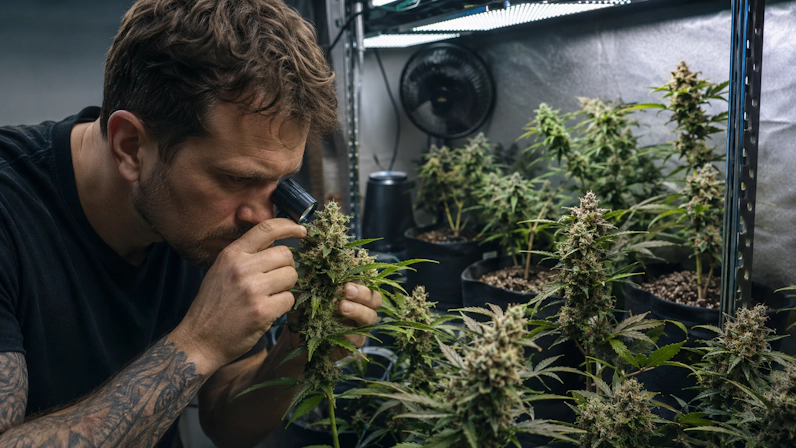
Here’s what to know before committing space to the D’lish weed strain.
- Difficulty: moderate
- Indoor vs outdoor: indoor is the better option
- Tent and space: a 4×4 handles three to four plants
- Lighting: strong light through flower drives the frost
- Temperature and humidity: aim for 70 to 80°F, with humidity near 50 to 60% in veg, dropping to 40 to 45% in late flower
- Training: topping and LST improve light penetration
- Veg period: four to six weeks
- Feeding: moderate nitrogen in veg, then heavier phosphorus and potassium in flower
- Flowering time: commonly reported at 8 to 9 weeks
- Yield: moderate to good
- Pest and disease management: airflow and defoliation
- Seeds available: harder to source than mainstream genetics, since this circulates largely as branded flower through boutique growers rather than seed banks
Similar Strains to D'lish

herb
- Zkittlez: a direct parent, and the source of the candy fruit that reviewers identify as the Z note.
- Sweet Retreat: the other parent, bringing the dessert and gas character underneath.
- Sherb Cream Pie: compared directly by a reviewer, matching on creamy sweetness with a savory edge.
- Runtz: also named in that comparison, sharing candy sweetness with more gas.
- Moonbow: the third strain in that reviewer’s comparison, with a similar fruit-and-cream structure.
- Gelato: comparable dessert profile on a similarly balanced effect.
Frequently Asked Questions
What strain is D'lish?
D’lish strain genetics are Zkittlez crossed with Sweet Retreat, making it a balanced hybrid, associated with Preferred Gardens and related California boutique programs. It’s also written D-Lish or D Lish. Several growers now run it, and the results differ noticeably between them.
Is the D'lish strain indica or sativa?
It’s a balanced hybrid, generally cited at 50/50, and the D’lish strain effects behave that way. Expect heavy eyes and weighted limbs alongside a relaxed rather than sedated headspace. One detailed reviewer called it strong and evenly balanced.
What is the D'lish strain THC percentage?
Most batches test between 22% and 27% THC, with many in the mid-20s and select phenotypes reaching past 27%. CBD sits below 1%. Reviewers consistently treat terpene content as the better quality signal on this strain.
What does the D'lish strain taste like?
Sugary vanilla and berry with savory citrus and grapefruit underneath, finishing equal parts sweet and savory. Some cuts carry a mint note, which one reviewer found too prominent. Flavor transfer from aroma to smoke rates highly across accounts.
How much does the D'lish strain cost?
Expect roughly $11 to $18 per gram depending on grower and market. Eighths typically run $35 to $60, with ounces landing between $200 and $320. Boutique weed growers price at the top of that range, so sales are worth waiting for.
Is D'lish a good strain?
Yes, and every D’lish strain review available says so. One reviewer scored it 12 out of 10, and another said it made him regret buying other brands that week. Cure quality, smoke smoothness, and flavor transfer earn the most praise. The sweet-and-savory combination is the only thing anyone disagrees about.
Is D'lish strain easy to grow?
Moderate difficulty and manageable with some experience. The main considerations are airflow around dense buds and cool nights late in flower for coloring. Getting the cure right is what separates good batches from forgettable ones.
What is D'lish strain flowering time?
Flowering runs 8 to 9 weeks indoors, with outdoor grows finishing early to mid-October in the Northern Hemisphere. Rushing the dry costs the savory and herbal notes first, which are the most distinctive part of the profile.
Herb Recommended Products:
READ MORE