
AP PHOTO
Major Update in Federal Marijuana Rescheduling: Here’s What Just Changed, and What This Means for Cannabis Users
The DOJ just moved FDA-approved and state-licensed medical marijuana to Schedule III. But the crackdown on possession is still happening, and recreational cannabis is still Schedule I. Here's what actually changed.

Federal marijuana rescheduling is the most talked-about cannabis policy story right now. On April 23, 2026, Acting Attorney General Todd Blanche signed an order moving FDA-approved marijuana products and state-licensed medical marijuana from Schedule I to Schedule III.
It’s the biggest federal cannabis policy shift in decades, but it’s also narrower than the headlines suggest.
Here’s what’s confusing people: the federal government just loosened how it classifies some marijuana, while at the same time prosecuting simple possession on federal land and keeping recreational cannabis classified as Schedule I.
That feels like a contradiction. It makes more sense once understanding what the order does and doesn’t change.
This article breaks down where federal marijuana rescheduling now stands, what changed under the current DOJ, and what all of it means if you’re someone who uses cannabis in 2026.
Where Federal Marijuana Rescheduling Currently Stands

Most people have a vague sense that rescheduling is “in the works.” Here’s a timeline of events related to the federal marijuana rescheduling, including where things stand today:
October 2022: The push toward federal marijuana rescheduling started back in October 2022, when President Biden directed the Department of Health and Human Services (HHS) and the DEA to formally review marijuana’s Schedule I classification.
August 2023: In August, the HHS completed that review and recommended moving marijuana to Schedule III, based on updated medical and abuse evaluations.
May 2024: The DOJ published a proposed rule to transfer marijuana from Schedule I to Schedule III marijuana status, officially kicking off the formal rulemaking process under the Controlled Substances Act. That process requires public hearings and a full administrative record. The DEA scheduled hearings to begin in December 2024, but a judge postponed those proceedings in January 2025.
December 2025: President Trump signed an executive order directing the Attorney General to complete the Schedule III marijuana reclassification.
January 2026: the DEA publicly clarified that even with an executive order, the rescheduling still has to go through the required administrative steps before any schedule change becomes law.
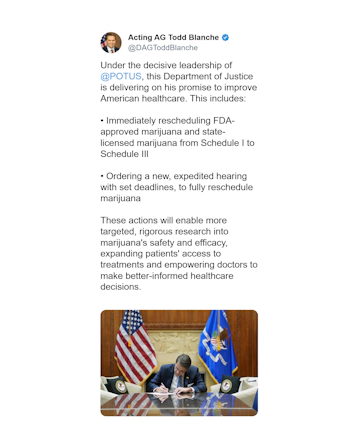
April 23, 2026: Acting AG Todd Blanche signs an order immediately rescheduling FDA-approved marijuana products and state-licensed medical marijuana from Schedule I to Schedule III. He also orders an expedited administrative hearing (set for late June 2026) to consider the full rescheduling of all marijuana.
In his post on X, Blanche wrote that the Department of Justice was “delivering on President Trump’s promise to improve American healthcare” and that the actions would “enable more targeted, rigorous research into marijuana’s safety and efficacy, expanding patients’ access to treatments and empowering doctors to make better-informed healthcare decisions.”
Important note: This rescheduling does not immediately legalize cannabis, and it does not affect the sentences of anyone currently incarcerated for marijuana offenses. It also doesn’t cover recreational cannabis. Marijuana or marijuana-derived products outside FDA-approved drugs or state medical programs remain Schedule I, subject to the same federal criminal sanctions they’ve faced for 50-plus years. That recreational piece is what the June hearing is expected to address.
What Schedule III Would Actually Mean
Schedule III is not legalization. The DEA’s own rescheduling notice says that even under Schedule III, marijuana would still be subject to the criminal prohibitions of the Controlled Substances Act. That’s straight from the federal government.
Here’s what federal marijuana rescheduling would change:
- Research — it becomes easier to study Schedule III substances, opening new pathways for clinical research
- Taxes — cannabis businesses would get relief from Section 280E, the provision that currently bars them from deducting normal business expenses
- Penalties — certain penalty structures would shift downward
Here’s what it wouldn’t change:
- Possessing, buying, or selling marijuana without DEA authorization would still be federally illegal
- The DEA retains full enforcement authority regardless of which schedule marijuana lands in
Even with Schedule III rescheduling, your use of cannabis would still be considered a federal crime. Legal scholars at Ohio State’s Drug Enforcement and Policy Center have been clear: rescheduling is an administrative classification change, not a reform of prohibition. The DEA keeps full enforcement no matter what schedule marijuana lands in.
That distinction between marijuana rescheduling 2026 expectations and the legal reality is something most readers don’t fully grasp, and it’s the key to understanding the contradiction we’re about to get into.
Marijuana Policy Shift Under Trump — Undoing What Biden Had Done
Biden issued mass pardons for federal simple-possession marijuana offenses, covering offenses on December 22, 2023. He publicly called on governors to issue similar relief at the state level. Behind the scenes, an internal DOJ memo instructed U.S. Attorneys to dismiss simple-possession cases, withdraw warrants and fees, and be careful before bringing any new cannabis cases.
In other words, Marijuana remained Schedule I, but the federal government was stepping back from low-level possession cases. For a lot of cannabis consumers, this felt like a big shift. It wasn’t. It was “prosecutorial discretion,” and prosecutorial discretion can be reversed by the next administration.
Which is exactly what happened.
AG Bondi, Trump, and Legal Controversy
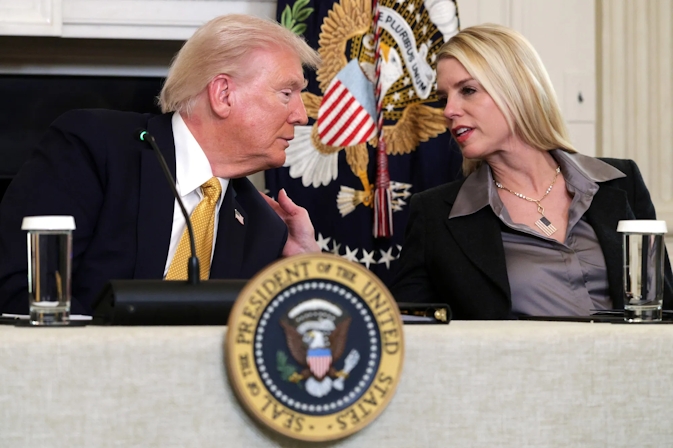
On September 29, 2025, the DOJ quietly rescinded Biden’s cannabis enforcement guidance. The public only found out about it because the U.S. Attorney’s Office for the District of Wyoming announced it.
Wyoming U.S. Attorney Darin Smith issued a memo stating that marijuana cases on federal land would now be “rigorously prosecuted,” reversing the prior standard.
Smith’s statement didn’t mince words: “Marijuana possession remains a federal crime in the United States, irrespective of varying state laws.” A spokesperson for his office told WyoFile that the Trump administration considers cannabis use a “public safety hazard.”
Congresswoman Dina Titus, co-chair of the Congressional Cannabis Caucus, sent AG Pam Bondi a letter demanding an explanation, pointing out the direct conflict between Biden’s pardons and the new prosecution directive. The Pam Bondi marijuana prosecutions story became a major flashpoint in cannabis rescheduling news.
According to the letter, the DOJ cannot undo Biden’s signed pardons since they are protected by the U.S. Constitution. What they can do is refuse to support expungement (the clearing or hiding of criminal records) or other relief for pardoned individuals, aggressively go after any new post-pardon possession, and reinstate maximum charging policies going forward.
The bottom line for cannabis consumers under Trump marijuana policy 2026: if you’re on federal land like national parks, federal buildings, or military bases, you’re back in real legal jeopardy for simple possession. The soft-enforcement window from the Biden era is closed.
Interestingly, former U.S. Attorneys from five different districts told Cannabis Business Times they never received any formal Biden-era memo telling them not to prosecute marijuana cases, which makes the whole situation even murkier.
Why Rescheduling Doesn’t Protect You From Prosecution

hERB
This is the part that confuses people, and it’s the most important thing to understand about federal marijuana rescheduling right now.
Rescheduling and prosecution policy operate on entirely separate legal tracks. One is an administrative rulemaking process run by the DEA, the other is prosecutorial discretion by U.S. Attorneys under the direction of the Attorney General. They’re different mechanisms under the law, and they don’t need to agree with each other.
The DOJ marijuana enforcement policy shift under Bondi doesn’t legally conflict with the rescheduling process. Rescheduling to Schedule III marijuana changes how marijuana is classified. It doesn’t change whether it’s illegal to possess. Those are separate questions under the Controlled Substances Act, and the administration can advance one while going in the opposite direction on the other.
For marijuana rescheduling 2026, this creates a specific political dynamic. The White House can point to rescheduling progress as evidence of a modern approach to cannabis policy, while keeping full criminal leverage in federal prosecutions. The delayed hearings and indefinite rulemaking timeline make this approach easier to maintain because there’s no final rule forcing anyone to take a definitive position.
Trump marijuana policy 2026 is, in practice, a split screen: progress on paper, crackdowns on the ground.
Where You're at Risk If Using Cannabis
The enforcement crackdown specifically targets federal land and federal jurisdiction. That means national parks, federal buildings, federally subsidized housing, and military installations. If you’re in a legal state and you’re not on federal property, day-to-day enforcement hasn’t changed much for most people.
But the risk is bigger for specific groups. If you live in federally subsidized housing, work on federal property, or use cannabis somewhere like Yellowstone, where you might not be thinking about federal jurisdiction, you’re exposed. Cannabis remains fully illegal under federal law, regardless of what your state says.
NORML called the new DOJ marijuana enforcement policy “inappropriate and misguided,” pointing out that nearly half of all U.S. states have legalized cannabis possession and that most Americans oppose using federal resources this way.
What the Industry Is Watching
For state-licensed medical marijuana operators, AG Blanche’s announcement is a genuine win. The big one is 280E relief—the tax provision that stopped cannabis companies from deducting normal business expenses because they sold a Schedule I substance.
With medical marijuana now on Schedule III, covered operators can deduct those expenses for the first time. But the rescheduling is narrower than the industry had hoped.
Adult-use recreational operators are still in Schedule I territory, which means 280E still applies to them. The split creates a two-tier federal tax environment inside the same industry: state-licensed medical operators get the break, recreational operators don’t, and multi-license operators will have to figure out how to navigate both systems simultaneously.
But the mixed signals, enforcement tightening on one hand while cannabis rescheduling news about Schedule III progress trickles out on the other, are creating real uncertainty. Businesses that were planning around a more permissive federal environment are now hedging. And equity-focused small operators are particularly squeezed: the capital and compliance costs of navigating this environment favor large, well-funded companies over smaller ones trying to get a foothold.
Nine Republican members of Congress even wrote to AG Bondi in August 2025 opposing rescheduling, and the House Appropriations Committee advanced a funding bill that would block DOJ from using any funds to reschedule cannabis. So the opposition isn’t just theoretical. It’s legislative.
Frequently Asked Questions
Does federal marijuana rescheduling mean weed is legal?
No. The April 23, 2026 order moved FDA-approved marijuana products and state-licensed medical marijuana to Schedule III, but it does not legalize recreational cannabis, and it does not legalize possession outside those specific categories. Legalization at the federal level would require an act of Congress, not a scheduling change.
Can Pam Bondi's DOJ undo Biden's marijuana pardons?
No. Presidential pardons are constitutionally protected and can’t be reversed by a subsequent administration. However, the DOJ can refuse to support expungement efforts and can aggressively prosecute any new marijuana offenses going forward.
Where am I most at risk for federal marijuana prosecution right now?
Federal land is the primary risk zone: national parks, federal buildings, military bases, and federally subsidized housing. If you’re in a legal state on non-federal property, day-to-day enforcement hasn’t changed significantly for most people.
What is 280E, and why does the cannabis industry care about Schedule III?
Section 280E of the Internal Revenue Code prevents businesses that sell Schedule I or II substances from deducting normal business expenses on federal taxes. If marijuana moves to Schedule III, cannabis companies could finally take those deductions, which would be a huge financial shift for the industry.
When will federal marijuana rescheduling actually be finalized?
Part of it already is. As of April 23, 2026, FDA-approved marijuana products and state-licensed medical marijuana are reclassified to Schedule III, effective immediately. The broader rescheduling, which would cover all marijuana, including recreational, is scheduled for an expedited administrative hearing in late June 2026. Legal challenges from anti-legalization groups are already planned, which could affect the timeline for any broader changes.
Is Trump for or against marijuana?
It’s complicated. Trump’s administration just delivered the biggest federal cannabis reclassification in decades by rescheduling FDA-approved and state-licensed medical marijuana to Schedule III. At the same time, federal prosecution guidance for simple possession on federal land has been ramped up under the current DOJ, and recreational cannabis is still Schedule I. The actions point in different directions, which is kind of the whole story here.
The Bottom Line

HERB
Federal marijuana rescheduling stopped being theoretical on April 23, 2026. FDA-approved marijuana products and state-licensed medical marijuana are now Schedule III, effective immediately—the biggest federal cannabis policy shift in decades. That changes real things: 280E relief for medical operators, easier research access, and federal acknowledgment of accepted medical use.
What it doesn’t do is legalize cannabis. Recreational marijuana is still Schedule I. Federal enforcement authority remains intact. The soft-enforcement window on federal land from the Biden era is still closed, and the DOJ’s prosecution guidance under the current administration hasn’t reversed. Two separate legal mechanisms continue to move in different directions at the same time, and understanding that split is the only way to make sense of federal marijuana rescheduling as it stands today.
The late-June hearing on broader rescheduling is the next thing to watch—it’s where the question of whether recreational cannabis gets covered will actually be answered. We’ll keep tracking the rescheduling hearings and enforcement developments as this unfolds.
The Herb Community

ELSA OLOFSSON
For more than a decade, Herb has been a gathering place for people who love, use, and are simply curious about cannabis. What started as a small corner of the internet has grown into a community where millions come to learn, share, and stay connected to the culture.
Here’s what you can tap into at Herb:
- Learning hub and guides that break things down clearly, from growing weed outdoors to understanding how terpenes impact your high
- News hub that spotlights the latest cannabis culture and policy shifts
- Dispensary directory to help you find licensed shops in your local area
- Monthly strain picks, featuring rotating Indica, Sativa, and Hybrid favorites
- Deals page, updated monthly with the best cannabis discounts available online
Stay connected with the Herb community by subscribing to our newsletter, following us on Instagram, and X for the latest in cannabis lifestyle and culture.
Herb Recommended Products:
READ MORE