Durban Poison Strain: Effects, THC Content & Review in 2026
The legendary landrace-derived sativa known for clear-headed energy
Herb
March 12, 2026
This article contains sponsored content. Some of the products featured are part of paid partnerships. This page explains how our process works.

Herb
The legendary landrace-derived sativa known for clear-headed energy
March 12, 2026
Durban Poison stands as one of cannabis’s most iconic sativa strains, known for a uniquely energizing and focused high that’s earned it the nickname “espresso of cannabis” among consumers. This landrace-derived strain linked to South Africa continues to captivate both recreational users seeking daytime functionality and medical patients exploring options for symptom management. With its reputation for a terpinolene-forward terpene profile and mid-to-high THC content, Durban Poison offers a distinctive experience that sets it apart from the sea of hybrid strains dominating today’s market. Whether you’re exploring cannabis strains for the first time or you’re a seasoned enthusiast looking for a dependable daytime option, understanding Durban Poison’s unique characteristics can help shape your cannabis experience.

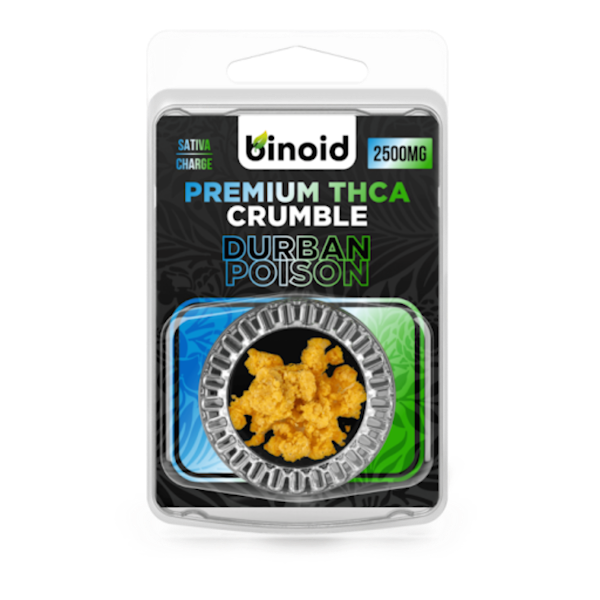
Durban Poison fans who dab, this one’s for you. Binoid’s THCA Crumble comes in a Durban Poison option, capturing the pure sativa’s energetic personality in concentrate form. The crumbly, easy-to-handle texture is rich in THCA and loaded with live terpenes. Once heated, it converts to THC for a fast-acting, intensely euphoric high.
You get 2.5 grams of clean, potent crumble per jar, ideal for dabbing or vaporizing. With 59 reviews and a sale price of $37.99 (down from $59.99), it’s a strong pick for heavy hitters chasing that daytime buzz. Low-temp dabs bring out the best of the flavor.
Durban Poison’s reputation stems from its landrace-derived genetics, a rarity in today’s hybrid-dominated cannabis market. Unlike most modern strains that are carefully crossbred for specific effects or appearances, Durban Poison traces its lineage to the coastal city of Durban, South Africa, where it developed its distinctive characteristics through adaptation to the local environment.
Durban Poison is widely marketed as a South African landrace-derived sativa, but modern commercial offerings are not uniformly verifiable as untouched 100% landrace stock. Even major breeders show internal inconsistencies in how they categorize it. Regardless, its genetic background explains the longstanding reputation it carries, even if real-world effects and chemistry still vary by grower, environment, phenotype, and batch.
In the 1970s, cannabis cultivation expert Ed Rosenthal acquired Durban Poison seeds in Amsterdam (not directly from South Africa as commonly misreported) and introduced them to the United States. Dutch breeders subsequently worked with the strain to stabilize it and reduce flowering time. Commercial Durban Poison lines are commonly sold as unusually fast-flowering for a sativa, often around 8–9 weeks indoors. This selective breeding preserved the strain’s energizing reputation while making it more economically viable for commercial cultivation.
Today, Durban Poison serves as parent genetics for numerous popular hybrids including Girl Scout Cookies, Cherry Pie, and Durban Cookies. Its recognizable character and reputation make it a valuable building block for breeders seeking to impart stimulating energy and productivity to new strain developments.
For those wanting to explore the full spectrum of cannabis genetics, Herb’s Strain Guides offer comprehensive information on landrace-derived strains and their modern descendants, helping you understand the differences and pick the best strain for your needs.
The effects profile of Durban Poison has earned it a devoted following among users who need cannabis that enhances rather than impairs daily functioning. Unlike many high-THC strains that produce sedation or mental fog, Durban Poison has built a strong consumer reputation for a clear-headed, functional high that’s particularly valued for daytime use.
When smoked or vaped, Durban Poison produces a rapid onset of effects within minutes. Duration generally tapers over roughly 2–4 hours after inhalation, though this varies by dose, tolerance, and product. The commonly reported effects include:
These reported effects make Durban Poison particularly popular among professionals, students, and creatives who want to maintain productivity while enjoying cannabis. Some consumers anecdotally prefer stimulating strains like Durban Poison for daytime use, but evidence does not support strain-specific medical claims for ADHD, depression, or chronic fatigue.
While generally well-tolerated by many users, Durban Poison can cause side effects in sensitive individuals or with overconsumption:
Proper dosing is crucial for maximizing benefits while minimizing risks. Starting with 1–2 inhalations and waiting at least 15 minutes before consuming more allows users to find their optimal dose without overconsumption.
Durban Poison’s potency profile is as interesting as its effects, featuring a combination of cannabinoids that contributes to its distinct character.
Commercial Durban Poison products are often in the mid-to-high THC range, but exact potency varies by phenotype, grower, and batch. Some high-THC retail batches have tested toward the upper end of the spectrum. However, what makes Durban Poison particularly interesting isn’t just its THC content but its broader cannabinoid makeup.
Some Durban Poison products are marketed as relatively THCV-forward compared with many strains, but actual THCV content varies widely and is often far below the 3–5% sometimes cited in popular cannabis media. Always check the COA for the specific batch you’re considering. THCV has earned the “diet weed” nickname for its purported appetite-modulating properties, but the human evidence is still preliminary and limited. Larger trials are still needed, and appetite suppression is not guaranteed and should not be treated as a dependable Durban Poison effect.
CBD is usually low in commercial Durban Poison products, while CBG may be present in small amounts but varies by batch. This cannabinoid profile, particularly the relatively low CBD, likely contributes to the strain’s stimulating rather than sedating reputation.
Beyond cannabinoids, Durban Poison’s effects are significantly influenced by its terpene profile. Many Durban Poison products are sold as terpinolene-forward, but exact terpene rankings and concentrations vary by batch and phenotype. Published chemotype work has even reported a Durban Poison sample that was beta-myrcene-dominant, which shows that terpene profiles are not universal across all products carrying this name.
Terpinolene is often marketed as an uplifting terpene, but the cannabis-specific evidence base for this claim is limited. Regardless, the terpene profile works alongside the cannabinoid content through the entourage effect, contributing to the strain’s overall character. Abstrax’s proprietary Terplytics system gives Durban Poison a “Haze Factor” of 99%, indicating extreme sativa characteristics in their framework, though this is a vendor-specific metric, not an independent industry standard.
Durban Poison’s sensory profile is as distinctive as its effects, offering a complex flavor and aroma that sets it apart from other sativa strains.
The aroma of Durban Poison is often recognizable to experienced users, featuring a sweet, spicy, anise-like scent with prominent notes of licorice, pine, and citrus. This distinctive profile is commonly attributed to its terpinolene-forward terpene composition, which creates a more complex and nuanced aroma than the simple earthy or skunky notes found in many cannabis strains.
The scent is often described as simultaneously sweet and spicy, with underlying herbal and floral notes that become more apparent upon closer inspection. When properly cured, Durban Poison tends to have a clean, bright aroma that lacks the musty or hay-like notes that can indicate poor curing or storage.
When smoked or vaped, Durban Poison delivers a flavor profile that mirrors its aroma, with sweet, spicy, and anise-like notes prominent on the inhale. The exhale often reveals more subtle pine and citrus notes, with a clean, smooth finish that lacks the harshness or chemical aftertaste found in some poorly grown cannabis.
The flavor intensity can vary based on growing conditions and curing methods, but high-quality Durban Poison consistently delivers a complex, multi-layered taste experience that rewards attentive consumption. This distinctive flavor profile makes it a favorite among cannabis connoisseurs who appreciate nuanced sensory experiences.
For those interested in growing their own cannabis, Durban Poison offers several advantages that make it appealing to both novice and experienced cultivators.
Durban Poison’s growth characteristics make it adaptable to both indoor and outdoor environments, though it thrives best in warm, sunny climates similar to its native South Africa. The strain is typically a tall, vigorous plant with potentially high yields, but height and output are phenotype- and environment-dependent. Some breeders report outdoor plants can reach 3–4 meters under ideal conditions.
The strain’s flowering time of about 8–9 weeks indoors is unusually fast for a sativa, which typically requires significantly longer to mature. This reduced flowering time makes Durban Poison economically viable for commercial growers while still preserving its sativa-leaning genetics and effects.
While relatively resilient, Durban Poison does present some challenges for growers:
Breeder descriptions often present Durban Poison as relatively hardy, but real resistance to mold and pests depends on phenotype and grow conditions. Its heavy resin production also makes it a popular choice for concentrate extraction, adding commercial value for extractors.
For detailed cultivation guidance, Herb’s How-To guides provide practical advice on various cannabis topics, including growing techniques and environmental management.
While Durban Poison stands out for its landrace-derived genetics and longstanding reputation, several other sativa strains offer similar energizing properties for users seeking daytime functionality.
These comparisons reflect common consumer impressions rather than settled scientific distinctions, as strain-level effect comparisons are inherently subjective:
Dutch Passion, in comparing Durban Poison and Sour Diesel, notes that both deliver strong sativa-leaning results, with Durban Poison leaning more toward spicy and herbal aromas. They also describe Durban Poison as having anti-anxiety and energizing qualities that boost creativity, though individual experiences will vary.
For users who enjoy Durban Poison’s effects but want to explore alternatives, these strains have comparable reputations for energizing properties:
Herb’s Strain Guides feature curated strain explainers and selection advice, making it easy to explore and compare top sativa strains based on your specific needs and preferences.
Locating authentic Durban Poison can be challenging in today’s market, where many products labeled as “Durban” are actually hybrids or crosses that don’t represent the original genetics.
When shopping for Durban Poison, look for these indicators of quality:
To help assess what you’re getting:
Authenticity claims are inherently difficult with cannabis. Lineage records, breeder provenance, and batch COAs can help, but terpene profile alone does not verify landrace authenticity.
Herb’s Dispensary Directory allows you to browse dispensaries by state and city, helping you find local sources. Additionally, the Herb Products Catalog surfaces flower from various third-party sellers, enabling you to compare options.
As one of cannabis’s most enduring strains, Durban Poison continues to maintain its popularity among both new and experienced users. The strain’s recognizable effects, unique flavor profile, and reputation for a functional high have earned it a permanent place in cannabis culture.
Current user reviews highlight Durban Poison’s appeal for daytime use, with many consumers praising its ability to support productivity. Creative professionals value its reputation for sparking inspiration, and consumers who prefer stimulating strains often gravitate toward it for daily use.
The strain’s status as a landrace-derived sativa adds to its appeal, as most modern cannabis has been extensively hybridized. While real-world effects and chemistry vary by grower, environment, and batch, Durban Poison’s longstanding reputation makes it a cornerstone strain for both recreational and medical cannabis communities.
For the latest updates on top strains and community trends, Herb’s newsletters provide bi-weekly and monthly insights into the cannabis landscape, including strain reviews and product recommendations based on community feedback.
Durban Poison is widely marketed as a South African landrace-derived sativa, but modern commercial offerings are not uniformly verifiable as untouched 100% landrace stock. Even major breeders show some inconsistency in how they classify it. Many products labeled as “Durban Poison” in dispensaries are actually hybrids or crosses that use Durban Poison as a parent strain. Authenticity claims are difficult to confirm; lineage records, breeder provenance, and batch COAs can help, but terpene profile alone does not verify landrace authenticity.
THCV has earned the “diet weed” nickname for its purported appetite-modulating effects, and some Durban Poison products are marketed as relatively THCV-forward. However, actual THCV content varies widely across products and is often far below the figures commonly cited in popular media. The human evidence for THCV’s appetite-suppressing effects is still preliminary, and appetite suppression is not guaranteed. Always check the COA for your specific batch, and don’t count on this as a dependable effect.
Many users describe Durban Poison as the “espresso of cannabis” because of its stimulating, focused reputation. However, cannabis and caffeine have entirely different pharmacology, so the comparison is more of a consumer metaphor than a scientific equivalence. Cannabis and caffeine work through different mechanisms, and claims about Durban Poison being free of jitters, crashes, or tolerance buildup are not clinically established. Some users enjoy combining small amounts of both, while others prefer one or the other, and your mileage will vary.
Durban Poison generally prefers warm, sunny conditions similar to its native South Africa, making outdoor cultivation challenging in cold regions. However, indoor growing with proper climate control can successfully produce Durban Poison anywhere. The strain’s tall growth habit requires height management techniques like LST or SCROG, and its approximately 8–9 week flowering time is relatively fast for a sativa, making it more manageable than other landrace-derived sativas that can take significantly longer to flower.
While Herb doesn’t provide medical advice, many consumers anecdotally prefer stimulating strains like Durban Poison for daytime use and report that its focused, energizing reputation aligns with their needs. However, evidence does not support strain-specific medical claims for conditions like ADHD, depression, or chronic fatigue. Individual responses vary considerably, and proper dosing is crucial to avoid overstimulation or anxiety. If you’re exploring cannabis for symptom management, consulting with a healthcare provider is always a good idea.
Hemp-derived THCa Durban Poison is produced from hemp plants that have been bred to express Durban Poison genetics and high THCa content. When decarboxylated through smoking or vaping, THCa converts to THC, producing effects similar to traditional cannabis Durban Poison. However, the legal status of hemp-derived THCa products is no longer accurately summarized by the original 2018 Farm Bill language alone; federal and state rules have tightened and remain in flux, with recent regulatory changes counting total tetrahydrocannabinols more broadly. Always check your state and local laws before purchasing. Traditional cannabis Durban Poison is only legally sold through jurisdictions with authorized medical or adult-use cannabis programs.