How to Buy Weed in London: Black Cabs, Gray Markets, and What Tourists Actually Do
London has no Amsterdam-style coffeeshops and no legal recreational cannabis. Here is what tourists actually face, why medical access is specialist-only, and where CBD fits in.
Every assumption about London’s cannabis scene needs correction: there are no Amsterdam-style coffeeshops, no legal recreational dispensaries, and the “black cab” delivery legend is more rumor than reliable service. The UK keeps cannabis as a Class B drug despite legalizing medical access in 2018, so the reality for tourists and residents runs between an illegal gray market and a legal pathway most visitors cannot use. The smart move is not to seek shortcuts. It is to understand the legal framework, the medical options, and the quality indicators that separate safe choices from dangerous risks in a market the Institute of Economic Affairs once valued at around £2.6 billion annually.
Below you will find a complete breakdown of London’s cannabis laws, how the gray market really works, what tourists actually encounter, the legal CBD landscape, the penalties for getting it wrong, and the safest way to think about the whole picture. Read this before you go.
Important: This article is for informational purposes only; not legal or medical advice. For adults 21+. Cannabinoid legality varies by state, and the federal hemp definition narrows in late 2026—verify your state’s laws and that the retailer ships to you before buying any cannabinoid products. Featured products are not FDA-evaluated and are not intended to diagnose, treat, cure, or prevent any disease.
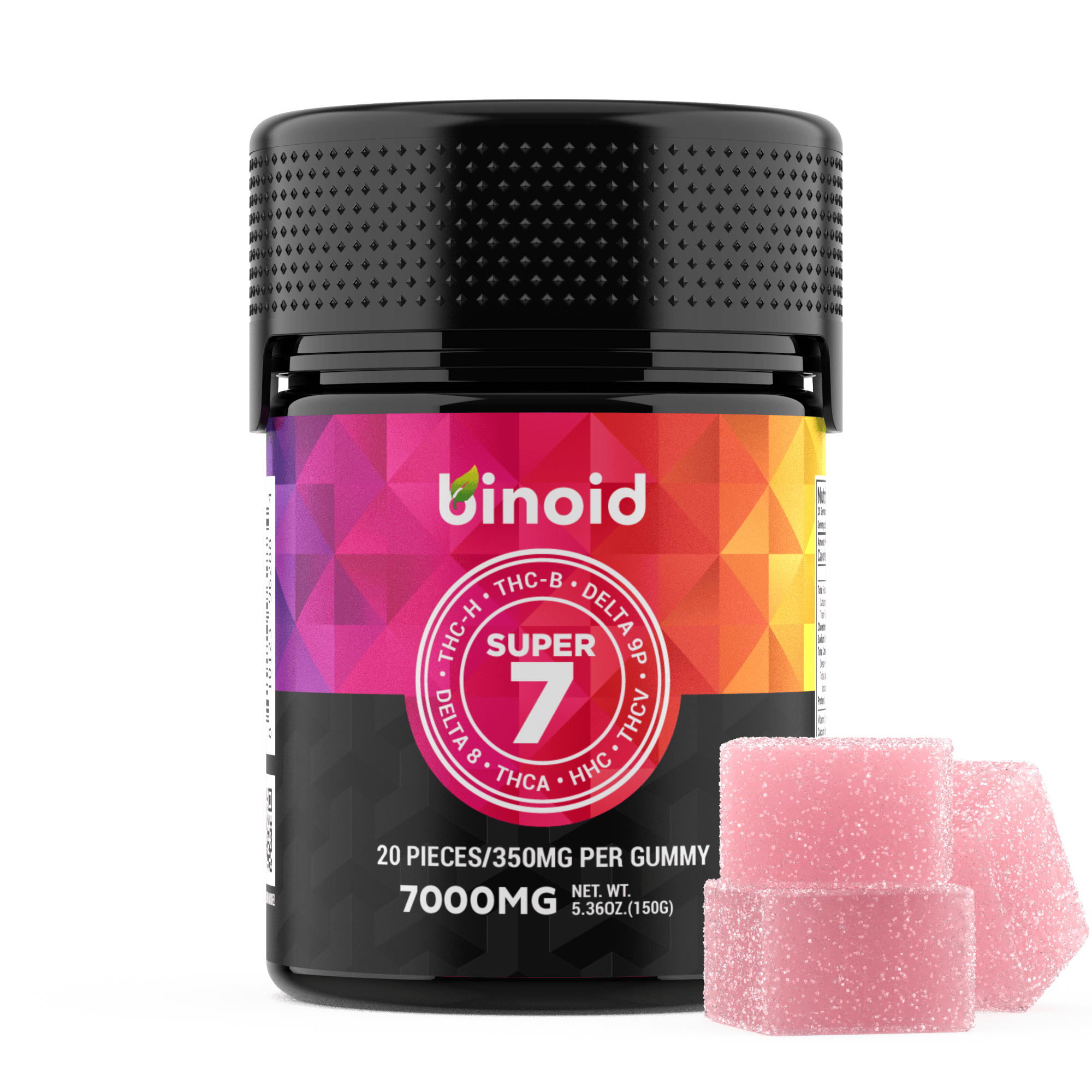
While London’s market stays stuck in legal limbo, hemp-derived options back in the States keep getting better. Binoid’s Super 7 Gummies stack seven cannabinoids (THCA, THC-H, THC-B, Delta 9P, Delta 8, HHC, and THCV) into a single 7000mg jar. That combination is the draw here.
Multiple cannabinoids working together produce a rounder, more layered effect than any one of them solo. The texture and formulation were rebuilt specifically to fit a higher cannabinoid load into each Grape Cotton Candy gummy. Potency like this demands patience, so start small and give it time. Check out the Super 7 Gummies at Binoid.
Recreational cannabis is fully illegal. Cannabis is a Class B drug in the UK, with possession carrying up to 5 years imprisonment and supply or production up to 14 years.
Medical cannabis is specialist-only. Legal since November 2018, it requires a prescription from an appropriately qualified UK prescriber and is not a practical route for short-term tourists.
No tourist exception exists. UK law applies equally to visitors and residents, and there is no legal recreational way for tourists to buy cannabis in London.
The gray market carries real risks. UK testing data show illicit cannabis products can be inert or adulterated, with one analysis finding 9.91% contained no active compound and a large share containing a psychoactive adulterant.
Enforcement is active. In the year ending March 2025, the Home Office reported a record 137 tonnes of herbal cannabis seized in England and Wales.
An estimated 1.4 million UK adults were thought to self-medicate with illicit cannabis, based on a 2019 estimate.
CBD is the legal alternative. Compliant CBD products are widely available, but the rules are specific and CBD is not a workaround for THC cannabis.
Is Weed Legal in London?
aron van de pol
London is not Amsterdam, Barcelona, or any US cannabis-friendly destination. Recreational cannabis is fully illegal throughout the UK, classified as a Class B drug under the Misuse of Drugs Act 1971. The penalties are serious: possession can result in up to 5 years imprisonment and an unlimited fine, while supply or production carries a maximum of 14 years.
There is one crucial nuance. Medical cannabis became legal on November 1, 2018, following changes to the Misuse of Drugs Regulations 2001. This created a two-tier system:
Recreational cannabis. Illegal for all purposes, including personal possession.
Medical cannabis. Legal only when prescribed by an appropriately qualified UK specialist, typically a doctor on the GMC Specialist Register for unlicensed cannabis-based products for medicinal use (CBPMs).
NHS access remains extremely limited in practice. Routine use is largely confined to specific licensed or recommended products for severe epilepsy syndromes, MS-related spasticity, and chemotherapy-induced nausea. Importantly, there is no blanket legal restriction limiting prescriptions to only those conditions. Prescribing is a specialist clinical decision, and NHS prescribing of unlicensed products has been rare in practice.
This gap created a private medical cannabis market that has expanded rapidly since 2018, though reliable patient-count estimates vary by source and methodology. For short-term visitors, this route is not practical: it runs through UK specialist consultations, and private prescriptions issued outside the UK are not valid for supply within the UK.
The Gray Market Explained
elsa olofsson
The reality for most London cannabis consumers, and virtually all tourists, is the illegal gray market. This unregulated trade persists because of the gap between the NHS’s restrictive approach and the private market’s high costs. The UK’s illicit cannabis market has been valued at around £2.6 billion annually, with London a major consumption hub.
The "Black Cab" Myth vs. Reality
Popular references to “black cab” cannabis delivery are not something we can verify. Despite occasional rumors, Herb could not confirm any legitimate or reliable black-cab cannabis service, and tourists should not treat such claims as safe, legal, or dependable. The Metropolitan Police conducts targeted enforcement operations, but there is no reliable evidence of organized black-cab dealing networks serving tourists or residents.
What tourists actually encounter is:
Street dealers in high-traffic areas like Camden, Shoreditch, and Westminster.
Social media and messaging-app connections.
Word-of-mouth networks among locals.
Informal hotel or hostel dealing, on occasion.
Quality and Safety Concerns in the Illegal Market
The unregulated nature of the gray market creates real health risks. UK-submitted data from WEDINOS, the Welsh drug-testing service, show that illicit cannabis products can be inert or misrepresented. In one analysis of 1,635 WEDINOS-submitted cannabis-product samples, 9.91% contained no active compound and 38.17% contained a psychoactive adulterant.
Separate Canadian studies have found high pesticide contamination in illicit cannabis, including myclobutanil, which can produce hydrogen cyanide when heated. Those findings come from non-UK markets and should not be read as London-specific, but they illustrate why an untested, unlabeled product is a gamble. With no regulation, there is no testing, labeling, or consumer protection of any kind.
Enforcement Realities and Geographic Variation
London enforcement varies by borough. Drug-related stop and search remains a primary tool for the Metropolitan Police, and cannabis remains the most commonly seized drug nationally.
Some areas have implemented diversion schemes:
Lewisham, Greenwich, and Bexley. Pilot programs offering a diversion from prosecution for younger adults caught with cannabis.
Westminster. Historically recorded among the highest drug-offense counts in London.
Despite local variation, national enforcement remains active. In the year ending March 2025, the Home Office reported a record 137 tonnes of herbal cannabis seized in England and Wales.
London's Cannabis Market for Tourists: What to Expect
anthony delanoixo
Tourists face particularly difficult circumstances. Unlike destinations with cannabis tourism infrastructure, London offers no legal recreational route for visitors to obtain psychoactive cannabis.
Common Tourist Misconceptions
Most tourists operate on several false assumptions:
“Medical legalization means easy access.” Medical cannabis requires a UK specialist prescription and weeks of processing, and prescriptions issued outside the UK are not valid for UK supply.
“London has cannabis cafes like Amsterdam.” No such establishments exist legally in the UK.
“Small amounts are tolerated.” First-time possession may be dealt with by a cannabis warning or other out-of-court disposal, but this depends on circumstances and can still be recorded by police.
“Street dealers are safe and reliable.” Contamination risks and legal penalties make this hazardous.
What Tourists Actually Encounter
The reality typically involves:
Street purchases with high risk of contaminated product, legal penalties, and overpayment.
Airport detection, which makes importing cannabis extremely risky.
No special provisions for tourists, since UK law applies equally to visitors and residents.
One important distinction: while there is no legal route to buy recreational cannabis in London, travelers carrying prescribed medicines that contain controlled drugs must be able to prove the medicine was prescribed to them and may need to follow Home Office controlled-drug travel rules.
Practical Advice for Tourists
Do not bring cannabis into the UK. Border detection is sophisticated and penalties are severe.
Do not buy from street dealers. Contamination risks and legal consequences outweigh any perceived benefit.
Consider legal CBD products. Widely available in health stores and online, containing no psychoactive THC.
Understand that “medical cannabis” is not tourist-accessible. It requires a UK specialist prescription.
One more piece of advice that’s easier to follow than the rest: leave your gear at home along with everything else. A dry herb vaporizer is only useful where you can legally get flower, and a device carrying residue is a conversation at the border that nobody wants.
So plan the good session for when you’re back in a legal market. TheAll New PAX Mini is our pick for that, and the 2026 version fixed the original’s real problems. The oven doubled to 0.5g, and four heat modes replaced the one automatic setting.
Purple (minimal vapor)
Green (conserve material)
Yellow (balanced, tasty vapor)
Red (clouds)
It’s 89 grams, heats in 22 seconds, runs on a single button, and costs $150 with a 3-year warranty when registered. Worth knowing it’s dry herb only, so don’t go looking for a concentrate insert. We coveredwhat changed and what didn’t in the new PAX Mini if you want the full details.
Quality and Safety: What to Look Out For
zouukk
Whether you are evaluating the illegal market or legal medical options, understanding quality indicators matters for safety and effectiveness.
Red Flags in Illicit Cannabis
When evaluating cannabis from unofficial sources, though it is strongly discouraged, watch for:
Unusual colors, such as excessive brown, black, or white powdery residue.
Chemical odors, harsh or solvent-like scents instead of natural terpene profiles.
Excessive dryness or moisture, since properly cured cannabis has slight springiness.
Seeds and stems, indicating poor processing.
Unrealistic pricing, since extremely cheap product often signals contamination or fakes.
Medical Cannabis Quality Context
Legal CBPMs are supplied through regulated medical and pharmacy channels, but many privately prescribed CBPMs are unlicensed medicines. NHS England notes that unlicensed products have not been assessed by the regulator in the same way as licensed medicines. That does not mean they are unsafe, but it does mean it would be inaccurate to describe all legal medical cannabis as fully approved or pharmaceutical-grade. What you can expect from the regulated route is professional oversight, standardized dosing information, proper packaging, and a documented supply chain.
Consumption Safety
For anyone using cannabis products, regardless of source:
Start with low doses, especially with potentially mislabeled products.
Do not use unregulated THC vape products. While vaporization may reduce some combustion-related toxins in regulated settings, illicit vape products carry serious contamination and mislabeling risks.
Never mix with alcohol, which can intensify effects and impair judgment.
Have a sober friend present, particularly for first-time or high-potency use.
Store properly, in airtight containers away from light and heat.
Herb’s consumption guides cover safe and effective use across various methods.
CBD and Legal Hemp in London
ELSA OLOFSSON
While psychoactive cannabis remains illegal, London offers abundant legal alternatives through CBD products. These non-intoxicating options carry no legal risk when they meet UK requirements.
Legal Status of CBD in the UK
The rules are specific and span more than one regime, so precision matters:
CBD food products sold in England and Wales should be linked to a credible novel-food application on the FSA public list. Products not on the list, or marked “Removed,” should be withdrawn.
Safety and labeling. Products must not be unsafe, incorrectly labeled, or contain controlled substances above permitted thresholds.
No unauthorized medical claims. CBD marketed as a medicine requires medicines regulation, so businesses should avoid presenting products as treating specific conditions.
The FSA also notes that products on its list are not formally authorized for sale and have not yet been fully assessed for safety, so “on the list” is not the same as a full safety guarantee.
Where to Find Legal CBD Products
Residents and tourists can legally buy CBD from:
Health food stores, such as Holland & Barrett, Planet Organic, and independent shops.
Specialty CBD retailers across London.
Online retailers that meet FSA requirements.
Pharmacies, with some larger chains stocking basic CBD products.
Types of Legal CBD Products
The legal market offers diverse categories:
Oils and tinctures for sublingual use.
Edibles like gummies and beverages with controlled dosing.
Topicals such as creams and balms.
Capsules for precise dosing.
Vape products, though vaping rules are complex.
Herb’s products catalog features information on legal CBD edibles and other alternatives available in regulated markets.
Benefits and Limitations of CBD
Some users report using CBD for anxiety, pain, or sleep, but consumer CBD products should not be marketed as treating medical conditions unless authorized as medicines. Evidence varies by condition, dose, and product type, and CBD can interact with certain medications. Quality also varies even among legal products, and the regulatory picture continues to evolve, so it is worth checking labels and FSA listing status before buying.
Cannabis Culture in London
bethany opler
London’s cannabis culture exists largely underground, shaped by legal restrictions and social stigma. Unlike cities with legal frameworks supporting public cannabis spaces, London’s scene stays private and discreet.
Social Norms and Etiquette
Privacy is paramount, with consumption typically in private residences.
Discretion is expected, as public use is rare and frowned upon.
Sharing is common among trusted circles.
Quality often matters more than quantity to London consumers.
The Medical Patient Experience
Legal medical cannabis patients face unique challenges:
Stigma and secrecy, with many concealing their legal use.
Documentation requirements, carrying prescriptions and original packaging when traveling.
Travel friction, with patients reporting difficulties despite legal status.
Employment uncertainty, since legal medical use does not guarantee workplace protection.
Underground Scene and Cultural Influence
Despite restrictions, cannabis maintains cultural influence through music and the arts, a growing reform-advocacy movement, informal knowledge sharing, and the global traditions brought by London’s diverse population. The contrast between this underground culture and a restrictive legal framework creates a complex landscape where consumers navigate between cultural acceptance and legal prohibition.
What Happens If You Are Caught
Understanding the legal consequences is essential to informed decisions.
Possession Penalties
First-time, small amounts. May be handled by a cannabis warning or other out-of-court disposal, depending on circumstances and police policy. These outcomes can still be recorded by police and may have future consequences, so they are not risk-free.
Repeat offenses. Likely prosecution with potential for a criminal conviction.
Cultivation. Growing cannabis without a license constitutes production, with no personal-use exception.
Impact Beyond Legal Penalties
A cannabis offense can affect employment, housing background checks, visa applications to other countries, and certain professional licenses. Herb’s legalization coverage tracks law and policy developments that may affect these frameworks.
Wait Until You’re Back in A Legal State
The safest play in London is simple. Don’t buy there, and don’t bring anything with you. Flying cannabis products into the UK adds customs law on top of the possession penalties above. Hemp-derived THC products sold in parts of the US aren’t treated the same way in the UK, so a vape from home is not a loophole.
Once you’re back in a state where it’s legal, that’s the time to pick things back up. If you like variety, theLoud THCA Rosin Switch Disposable is built for it. It’s a 3.5g dual-chamber vape filled with solventless THCA rosin from organic, non-GMO hemp. Solventless means the rosin is pressed out with heat and pressure instead of chemical solvents. One button lets you toggle between two strain chambers or switch into dual-strain mode. Pairings include Sour Maui with Dream Berry and Cookies Haze with Purple Passion, so you can move from a sativa to an indica without swapping devices. It also has a ceramic coil, a preheat setting, an LED display, and USB-C charging.
Resources for Cannabis Education
john cameron
Navigating London’s landscape calls for reliable information. Understanding strain characteristics, consumption methods, and safety practices helps consumers make informed decisions.
Understanding Cannabis Strains
Knowledge of strains helps anticipate effects and select appropriate products:
Indica strains are typically associated with relaxing effects.
Sativa strains are generally linked to more energizing experiences.
Hybrid strains combine characteristics of both.
THC vs. CBD content determines psychoactive potency and therapeutic potential.
Herb’s strain guides provide detailed information on effects, flavors, and characteristics.
Smoking. Rapid onset, shorter duration of roughly 1 to 3 hours.
Vaporization. Similar onset to smoking with potentially fewer respiratory irritants in regulated settings.
Edibles. Delayed onset of 30 to 90 minutes and longer, more intense effects.
Sublingual. Moderate onset of 15 to 30 minutes.
Topicals. Localized effects without psychoactivity.
Harm Reduction Strategies
For those who choose to consume despite legal risks:
Start low, go slow to assess tolerance.
Avoid mixing substances, particularly alcohol and other depressants.
Avoid unregulated products, since testing is rarely possible.
Have a safety plan with water, a comfortable setting, and sober support.
Know your source rather than relying on random street purchases.
Herb’s how-to guides offer practical, evidence-based information from quality identification to consumption techniques.
Why Herb Is a Resource Tourists Rely On
Herb
London’s cannabis landscape is complex, which is exactly where reliable education earns its place. Herb provides resources for cannabis knowledge and product discovery that hold up across very different legal markets.
Herb’s platform brings together:
Strain guides. Detailed strain profiles covering effects, flavors, and characteristics.
Product knowledge. Clear reviews of cannabis products from flower to edibles to accessories, helping consumers recognize quality in legal markets.
News and culture. Ongoing industry coverage of developments and policy changes worldwide.
Education. From beginner guides to advanced techniques, content that supports informed decisions.
For travelers who want safe, legal, and informed cannabis experiences, Herb’s combination of strain information, product knowledge, and practical guidance provides the grounding to navigate an unfamiliar market with confidence.
Final Verdict
London is a world-class destination, but cannabis access is not part of what it offers visitors. Here is how the decision breaks down for cannabis-conscious travelers:
Hoping for a coffeeshop experience? It does not exist here. There are no legal recreational dispensaries or cannabis cafes anywhere in the UK.
Counting on medical legalization as a workaround? It is not one for tourists. Medical cannabis requires a UK specialist prescription, and prescriptions from outside the UK are not valid for supply in the UK.
Tempted by the street market? The risk-reward is poor. UK testing data show illicit products can be inert or adulterated, and the legal penalties are real.
Want something legal while you are here? Compliant CBD products are widely available in health stores, pharmacies, and online, though they are not a substitute for THC cannabis.
Carrying prescribed medicine that contains a controlled drug? Bring proof it was prescribed to you and follow Home Office controlled-drug travel rules.
The honest answer to “how to buy weed in London” is that there is no legal recreational route, the gray market carries genuine legal and health risks, and the legal medical pathway is specialist-only. For broader context on cannabis travel and product knowledge, Herb’s guides section has the full picture.
Frequently Asked Questions
Is it legal to buy weed in London?
No. Recreational cannabis is fully illegal in London and throughout the UK as a Class B drug. Medical cannabis has been legal since November 2018, but it requires a prescription from a qualified UK specialist and is not a practical route for tourists. Possession can carry up to 5 years imprisonment and an unlimited fine, though a first-time offense with a small amount may be dealt with by a cannabis warning rather than prosecution.
Do black cabs really deliver cannabis in London?
The idea of “black cab” cannabis delivery is not something that can be verified. Despite occasional rumors, there is no reliable evidence of a legitimate or dependable black-cab cannabis service, and tourists should not treat such claims as safe or legal. In practice, people encounter street dealers in areas like Camden and Shoreditch or informal networks, not licensed taxis providing cannabis.
How do tourists typically find cannabis in London?
Most attempts run through street dealers in high-traffic areas like Camden, Shoreditch, or Westminster, which carries significant legal and health risks. Some travelers try to bring cannabis into the UK despite sophisticated border detection. The legal medical pathway requires a UK specialist consultation and weeks of processing, making it essentially unavailable to short-term visitors.
What are the risks of buying cannabis from unofficial sources?
Illicit cannabis can be inert or adulterated. UK testing data from WEDINOS found that, in one analysis, 9.91% of submitted cannabis-product samples contained no active compound and a large share contained a psychoactive adulterant. Non-UK studies have also found pesticide contamination in illicit cannabis. On top of the health risks, buyers face legal penalties including possible imprisonment and a police record.
Are CBD products legal and available in London?
Yes, when they meet UK requirements. CBD food products sold in England and Wales should be linked to a credible novel-food application on the FSA public list, must not be unsafe or incorrectly labeled, and must not contain controlled substances above permitted thresholds. These non-psychoactive products are widely available in health food stores, specialty retailers, pharmacies, and online, and include oils, edibles, topicals, capsules, and vape products. CBD is not a legal substitute for THC cannabis.
This article is for informational purposes only and does not constitute legal advice. Cannabis laws vary by jurisdiction and are subject to change. Always verify current regulations with official sources before traveling. Herb does not encourage the purchase or use of cannabis in jurisdictions where it is illegal.